Conservation

As my personal energy waned — lost to sleep deprivation, summoned by clay sculpting, expended via sightseeing, drained through armpits, hands, and feet, tapped by mobile phone manipulating*, stolen by rupee and calorie counting, challenged by curriculum planning, finished by total classroom overhaul and communication through several layers of go-betweens — I observed our interpersonal energy wax.

I could read their moods better, and they could read mine. Our trust was growing. Our walls were tumbling. Mine, Emily’s, Malika’s, Monali’s, Sundar’s (our driver for today, who waited for us patiently as we melted into the masses and reappeared 45 minutes later), Vasundhara’s, Shiv’s (who followed us to our apartment after a long day’s work and showed us how to turn on the hot plate, enabling the transformation of dangerous vegetables into nutrition-sustaining supper). It might be audacious to say, but maybe even India’s.

Today, Emily’s batteries literally ran out and recharged. We discovered that the A/C couldn’t run last night because I’d flipped the wall switch that cut off its power. We caffeinated three times — morning, noon, and night — to sustain our work-play-work lifestyle. We cooled it down with domestic gin & tonic and all-American Gilmore Girls. We also charmed Sunayha and Hash, the proprietor and little rascal of a small arts center, respectively. There was the plump woman in the sari who kept turning around to gaze at us and chuckle as we twisted our way toward the shrine. A couple in the elevator remarked how sweet it was that we thanked the operator in Hindi while they uttered “thank you.”

“The law of conservation of energy is a law of physics. It states that the total amount of energy in a system remains constant over time (is said to be conserved over time). A consequence of this law is that energy can neither be created nor destroyed: it can only be transformed from one state to another. The only thing that can happen to energy in a system is that it can change form” (Conservation of energy).

In the land that long ago spiritualized this law (reincarnation by another name), I’m living its wisdom. You get out what you put in.
Continue reading
Perspective

Point of view is a powerful thing.

You come to India expecting mobs, reek, cacophony, vibrance, destitution, opulence, lawlessness, bureaucracy… and you might wind up disappointed. Hard to say. Have you gone it alone in Senegal first? Are the servants of Mumbai’s upper class attending to you presently? If so… then yes. You might find yourself remarking, as my roommate/co-teacher Emily and I did, cushioned in the leather-upholstered, air-conditioned private car driven by our employer’s chauffeur, that this is no big deal.

At the same time, it’s an enormous deal. We traveled halfway around the planet!

(And it took less than a day. From LA to Frankfurt, I chatted with an LA-based, ethnically Greek, dyed-in-the-wool New Yorker who’s promised to introduce me to a man whose family owns most of Santa Monica’s streets (?), and a mother and daughter giddily anticipating 15 days in Italy and dreaming of improvements to Toyota’s philanthropy. In Frankfurt, I walked off the turbulence, looked over foreign interpretations of American food, books, and magazines, snoozed for 30 minutes on a thoughtfully placed cot, and skedaddled. From Frankfurt to Mumbai, I was out like a light. Presto. Semi-circumnavigation.)

The time difference between LA and Mumbai? 12.5 hours. Who knew that there were halves? That’s how far away I am – the international dateline is divided up into fractions!

(And yet, you can call me at my regular phone number as if I were in LA/Glenview/Somerville right beside you – no financial difference on your end or mine. Connection’s clear as a bell.)

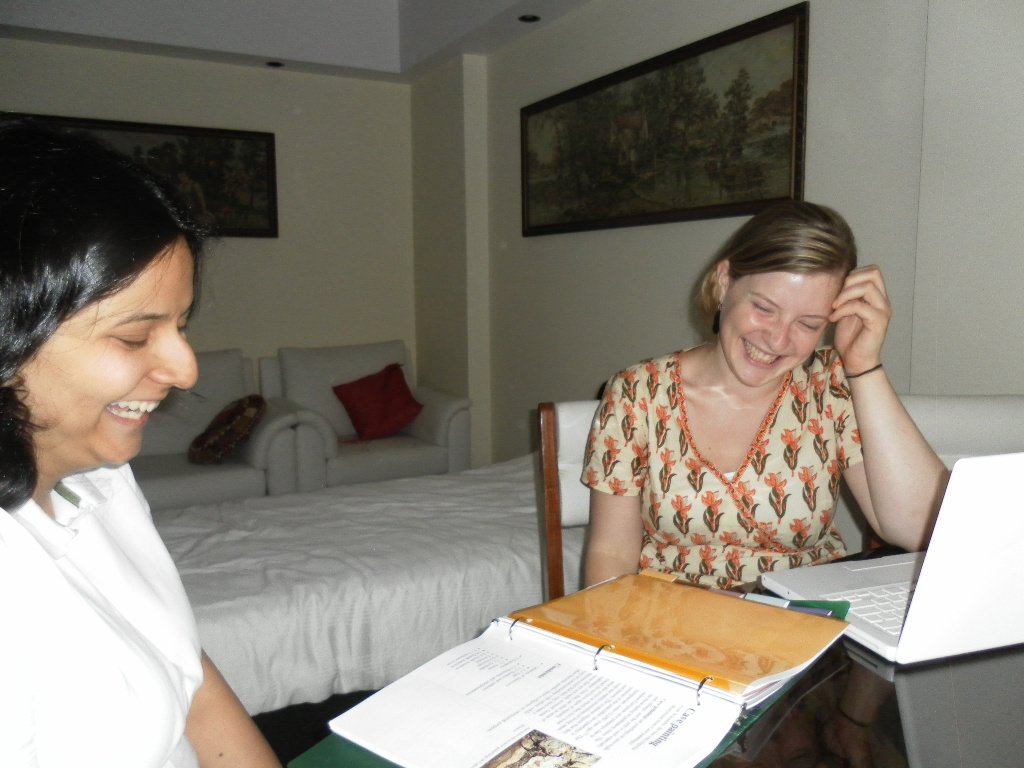
We spent part of the day with Monali, our boss Vasundhara’s assistant, and the other part with Malika, our Indian-based co-teacher*. We observed their subtly different cultural practices, the nuances in their account-making. We wondered how nationality shaped our views, and how class shaped theirs. We contrasted the stories and experiences of our predecessors to our own observations and activities. “Some things in Mumbai are cheap if you compare them to the States,” Malika explained. “But Mumbai is not cheap…”

The view out our living room window to the right? Luxurious residential highrises. The view out the left? A glimpse of the slum.

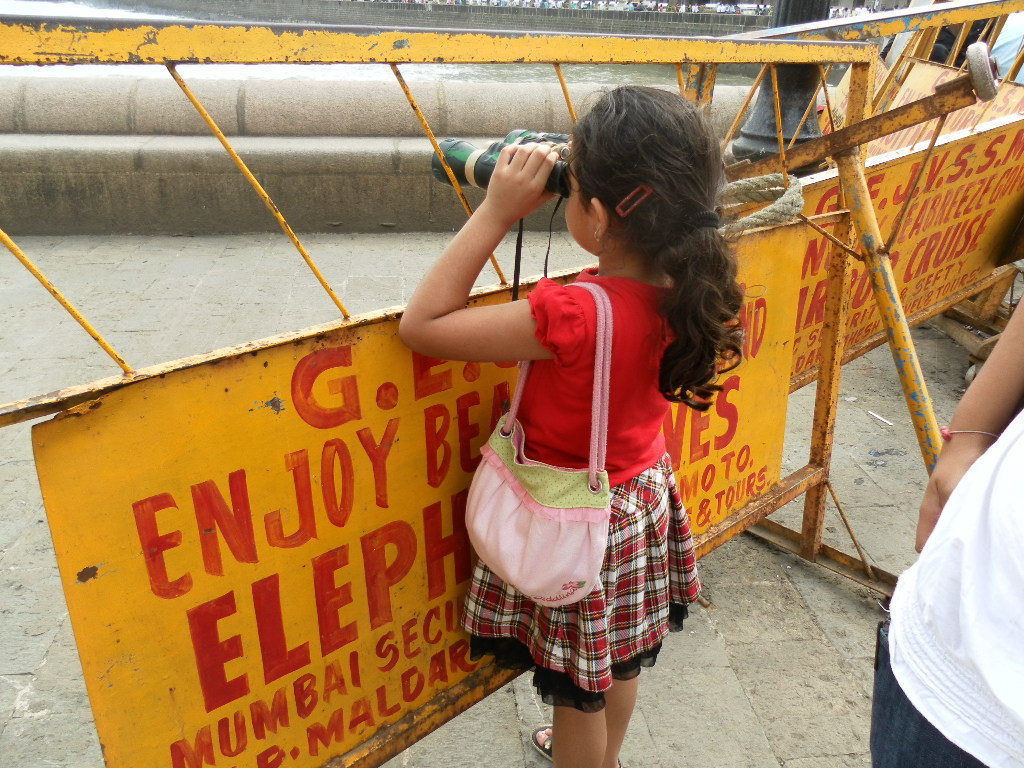
As we exited the bustling vegetarian restaurant where we had supped, a popular destination for upper middle-class families, Malika bestowed upon grimy beggar children the leftovers that our round-bellied, pathogen-averse bodies couldn’t handle. She was careful to give the bags to girls and to admonish the boys who sought to tear the foodstuffs from their hands. I watched the second girl, a scrappy fighter who lost the battle for the outer bag but won the war for the inner container. She scowled and held on. What is justice when all are hungry?

The driver pulled up and we slid into the backseat, reuniting with the bags of high-quality, culture- and climate-appropriate tunics we had purchased hours earlier. “No big deal,” we sighed, as Vikram sped towards the Jollymaker III, honking the whole way.

It’s not our fault that our amenities are gilded. But if we fail to challenge this, to complacently ride in our privileged bubble, then we will be at fault. We will have turned this opportunity into a restriction, fashioned a gilded cage that keeps out alternate realities and holds hostage our potential experiences and understandings.

From now on, we vowed: We’re walking.
Continue reading

Flow-going


I leave for India tomorrow.

I was supposed to leave last Thursday. And then this past Tuesday. And then the day after tomorrow. Now it’s tomorrow. Tomorrow it is.

I was supposed to write and edit a book chapter back in March. Then pushed it to April. May. Late May. Wrote through early June. Will finish it today. Has to be today.

Yet this morning, instead of setting down to edit, I began revamping this website.* Why? Rebelliousness? Lack of discipline? Divine inspiration? Perhaps a bit of all three, plus a dose of pragmatism. If you hadn’t heard, I leave tomorrow (used to be the day after tomorrow, but not anymore. Tomorrow it is). I plan to blog from abroad and will publicize this website’s presence to my network (677 friends on Facebook, 141 connections on LinkedIn, 814 spammers eager to promote chest fat loss and colon cleanses, among other gems).

So sometimes plans change — whether due to whim or necessity, sometimes plans change. And so I must go with the flow. My uptake of flow-going? Slow-going. Yesterday I fumed about my lack of control. Today I despair of this wrench in the work gears that I threw in myself.

Maybe that’s why I study the primary skills, basic competencies that help us remain agile in a digitally integrated, socially connected world of constant change. I may say that it’s for the children, but maybe what I’m really trying to do is save myself. Maybe that’s all that scholarship boils down to, oddballs’ attempts to figure out and fix themselves…

My mission is to internalize the lessons I teach, faithfully practice what I preach. I’d like to transition more gracefully, frame more positively, live more serenely, accepting and celebrating the flow, the now, the unexpected, the uncontrollable, as lately spoken of and consciously practiced by Krissy and Arian, Lindsay, Meg, Geetha, Sarah, Arvind, and my beloved mama.

India is the perfect place to embrace this challenge: birthplace of Buddhism, site of terrific tumult. This, and so many other reasons, make me lucky, so lucky… While I’m boarding a Lufthansa flight tomorrow (used to be Continental, then British Airways, but now it’s Lufthansa), I’m going with the flow today. And hopefully tomorrow… and the day after tomorrow… and the one after that…

Continue reading

Patterns

You have to listen for them. They’re there.

I was blessed back in 1998 (to be technical, I’ve been blessed every day before and since, but anyway) when I was cast in Northwestern University’s Titanic Players and began to study improv. I could wax for hours in pretentious, art-meets-philosophy mumbojumbo-speak about how improv is life, but I’ll spare us all the trouble. You’re welcome.*

Laura and I go back to 1996, a coupla north suburban Chicago speech team kids diving into the dysfunctional waters of the National Forensics Tournament in Fayetteville, NC… We were also teammates on Titanic. Last night, I saw Laura improvise with Chet Watkins in New York City. And while I’m far from my collegiate crisp salad days in Titanic, far even from my mid-20’s wilted greens days in Valid Hysteria, I like to think I’ve still got the eye, or the ear, for improv.

Patterns were everywhere.

The great improvisers recognize a pattern’s potential with the second element aired, and cement it for the rest of us with number three. Decent improvisers respect number three.  Greatness again can be achieved or avoided in what you do with it. The greats play the pattern, just play out the game the pattern delivers, so simple, so satisfying. The less great complicate; they deny the pattern, think they’re better, more clever than the pattern…

Let’s not get too technical, that really isn’t the point. Laura and I talked about her show a bit as we trekked out to Brooklyn, then switched to relationships.** We talked about me and mine, her and hers, our friends and theirs. Was it the priming device of improv that night, or the cognitive framework of improv in general, that influenced our perspectives? Laura called out the first one, a doozy, that.

Patterns were everywhere.

I’ll let you in on a little secret: Fundamentally, improv isn’t really about patterns… not really. Improv is about listening. I foreshadowed it in the first paragaph, saying you had to listen for em. You see how I did that? :-)

Our challenge, then, is to listen. You do need a little savvy to distinguish the pattern from the noise. Sure. But if you’re not listening in the first place, you won’t pick up on a blessed thing — nothing. It’s all a bewildering, limitless expanse, no knowing what’s coming next, no smart way to accommodate.

In The Tipping Point, Gladwell disclosed how telegraph operators analyzed enemy communications. This is separate from Bletchley Park, Alan Turing, the Enigma machine, all of that. Regular old telegraph operators learned their counterparts’ “fist,” or the unique signature with which they communicated — their pressure and tempo on the telegraph keys, as well as the expansiveness and pacing of their interpersonal chatter. While the Allied listeners didn’t know precisely what the Axis operators were saying, they knew which unique communicator was doing the talking. Gladwell likened this to a relationship’s DNA, an ingrained communication style shaping each interchange — a dynamic. A pattern.

So what are we going to do with it? How do we achieve greatness? To what extent are our personal and interpersonal patterns inescapable? Where is innovation possible, advisable, not just a (doomed?) vanity project of proving one’s “extraordinariness,” and where do we surrender to the pattern and play it out (or exit stage left)?

Tonight I’ll take in Meg‘s improv show with The Baldwins. Meg has been one of my best friends since 1994, and thanks to her and her fiance, my car stereo/heart is richer by two CD’s (lady power mix and sad country, respectively). Wonder if/how we’ll hear the patterns… and what we’ll do next.

*I happen to believe that improv is life, and improv’s approaches to good playing could be embraced as approaches to good living (shouldn’t life be lived playfully, afterall?). But then maybe you’ll come back with an example of how yoga or guitar-playing is life and I just really don’t want to get into it. ;-)

**See, this is where long-form improvisers would chime in, Improv is relationships!

Renewal

You know how they say, What once was old is new again?

Today I (re)visited Tufts University’s Eliot-Pearson Department of Child Development, site of my 2004-2006 MA studies. How lucky I am to have worked with such wise and caring teachers, who generously shared their time: over a cup of tea in Ball Square (thank you, Martha!); in the director’s office of my white knight, the Eliot-Pearson Children’s School (thank you, Maryann and Debbie!); to and from Powderhouse Square’s Dunkin Donuts (thank you, Chip!); and in the car of a friendly GTA passerby (thank you, David and girl whose name I can’t remember!).

I’ve assembled their valuable words of advice for us all to process and enact in real life. Their implicit meta-message: Don’t lose heart. The object lesson in this homecoming: Don’t lose people.

-Life has phases and cultures have orientations. Our youthful, Western passions may fade with time and/or never attain such manifestation/idealization elsewhere. Recognize and celebrate changes across the lifespan.
-Certain academic departments do value applied work and can allow young parents to survive.
-Activities should be evaluated in terms of their cost-benefit to professional and personal matters.
-Academia offers June, July, and August (plus Winter Break!). While you have to work hard eight months of the year, those three-ish months off are a beautiful thing. So is being paid to think…
-At certain academic departments, you can clearly understand expectations, affably negotiate politics, and ruthlessly set limits regarding work time and personal time.
-Writing time and personal time should be deliberately scheduled and conscientiously respected.
-It is important that the university not only appreciates but values your work. Without the attachment of meaningful value, people-pleasers must say “no.”
-Following your passion will lead you where you’re meant to go.
-Invoking your passion by asking “How does this relate to my key priority/area of interest?” should be regularly done so as to ensure both its pursuit and your sole participation in significant projects that advance your agenda.
-Appreciate contextual features that influence your work’s impact. Be realistic.

Also shared time with dear friends from back in the day, who have vitally remained my friends to this day, and don’t show signs of stopping. Thanks to old friends of friends (Tim), old friends (Jenn, Yali, Geetha, Erika, Kelli), old friends out of context (Meg, Meryl), newer friends out of context (Jinah), new friends (Christina, Emily, Julie, “Mussels”), and the old friends who will variously host and entertain me in the Big Apple (Laura, Jordan, Marci, Ed, Lucy, Meg, Happy, Waylon, Willie, the Griffiths, the Andersons, Arian, Krissy, Olive Joon, and Ivy Shireen).

Lately feeling like things are coming full circle… or like I’m on one of those spiral staircases, looping back to the origin, but happen to be up a level. Let it be so.

I’m old(er) but I’m new again.